Mint a share of a mining party and mine as one. Below it, our ORE Parties calculator.
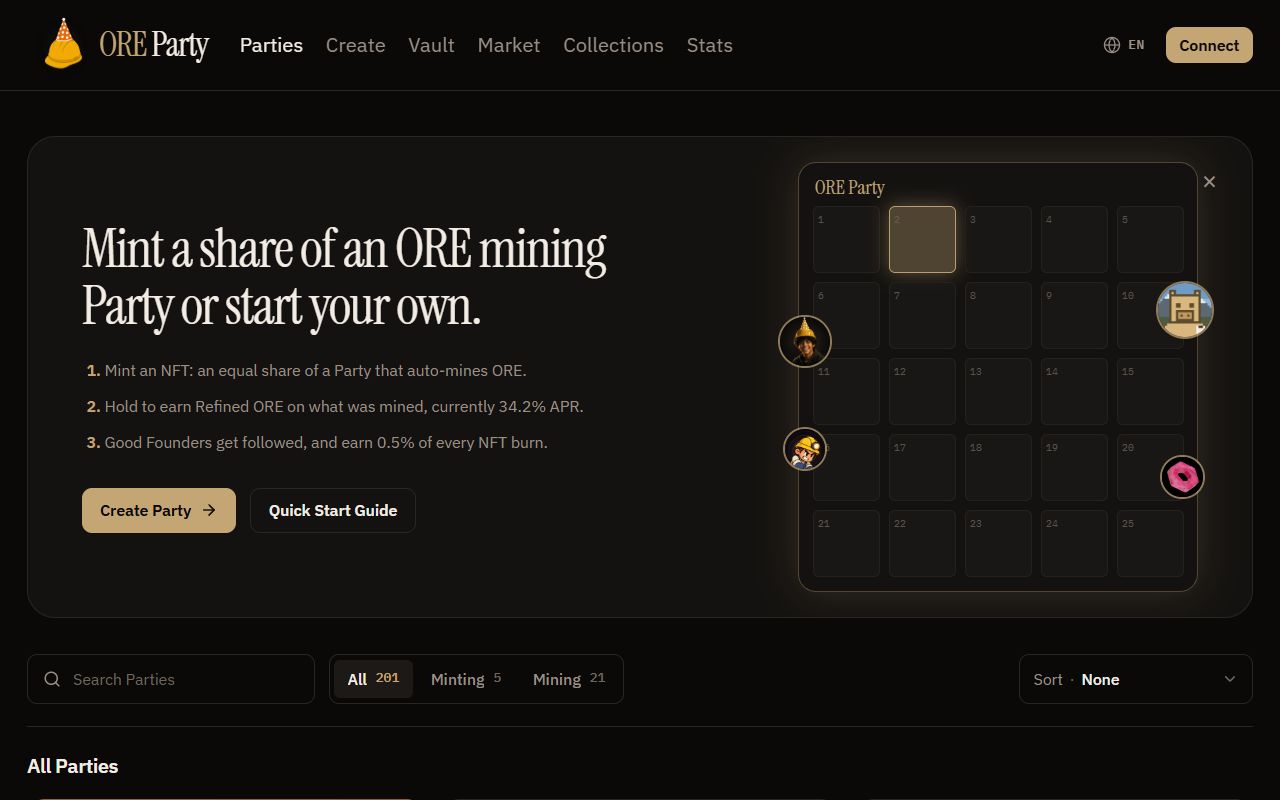
Each party is a small NFT collection. Minting one NFT buys an equal share of a party that mines ORE on its own, with the tiles, budget and Motherlode range its founder picked. Burn the NFT to claim your share of what the party mined.
Parties minting now, a leaderboard of every party, what their settings actually did, and a designer to try your own.
The gold numbers are live and update on their own.
—
Real edge is the least a mined round beats the ORE price by, after the 1% admin fee. SOL that lands after the bot's check can cut it. Run times count how many of the last 100 rounds would have passed the filter at today's prices.
Expected Solo is how many solos a party's stake share should have won on average over its rounds. Compare it with Solo Won: 5 won against 1.5 expected is a lucky run. Solo-only parties show — because they have no split wins to read a share from.
Risk / Reward is the party's variance: how far luck can move its ORE from its average, worked out from its tiles, stake share, rounds and Motherlode range. Higher ±31% means about 2 runs in 3 land within 31% of average, and the rest land further out. Expected ORE per SOL shows that as a range, so 0.47–0.90 means about 2 runs in 3 land there. It isn't a rating: lower is steadier, higher can win more and can fall short more. Under ±15% is Lower, under ±30% Medium, the rest Higher. Parties still minting are worked out at today's market as if they fill. Across 67 real parties, 69% landed inside their range and 96% inside double it. Solos drive most of it.
What 67 parties showed, 23 Sep to 1 Nov:
Party grades are gone: with luck taken out, they didn't predict results.
Ended and mining parties grouped by one setting at a time, showing the median party in each group so one big party can't decide a row. Value per SOL prices the ORE at the time it was mined, which takes ORE's price rise out of the comparison. Without luck is the same median with each party's solos and Motherlodes at their average, so it's the column to compare.
| Setting | Group | Parties | SOL used | ORE per SOL | Value per SOL | Without luck |
|---|
Try settings before you launch, projected with the live market numbers.
ORE Parties are run by other people on ore.party. Projections are estimates and luck decides any single party. Not financial advice.
Run by other teams, not ORE DOJO. Facts from their own sites, checked November 2026. Check their site before you mine.